
A plaque commemorating the controversial speeches given by Frank Wilkinson and Herbert Aptheker across the campus wall during the Speaker Ban. https://docsouth.unc.edu/commland/monument/168/
On June 25th, 1963, the “Act to Regulate Visiting Speakers” was passed. This would later be known as the “Speaker Ban Law”, as the bill served to restrict the freedom of speech on North Carolina public college campuses. The ban targeted and prohibited self proclaimed communists and those who pleaded the 5th when asked if they were communists from speaking at state-sponsored institutions. The student body of the University of North Carolina at Chapel Hill was strongly opposed to the legislation, and it was viewed to be a retaliation against UNC’s liberal atmosphere and support of civil rights.

The ban was hastily put together and passed; it was modeled after an Ohio house bill brought to NC legislators’ attention on June 21st, and four days later house legislator Phil Godwin introduced the bill. The normal rules of consideration were suspended, and four minutes later the bill passed the house in a voice vote. The senate received the ban immediately, and State Senate president Thomas Clarence Stone pushed it through with three readings and voice votes.
The university’s generally progressive stance on the civil rights movement was believed by conservative lawmakers to be stirring up unrest among blacks, and due to the Cold War era tensions were high between the government and critics of the government. This discrepancy blurred the lines between opponents of communism and opponents of racial change.

On UNC’s campus, students began a movement to counter the bill. William C. Friday, president of the UNC system, and the University Board of Trustees agreed to support the repeal or modification of the ban. At President Friday’s request, governor Dan Moore created a study commission to propose revisions to the law. In 1965, the law was amended, but student leaders felt that any restrictions on speakers were unacceptable.
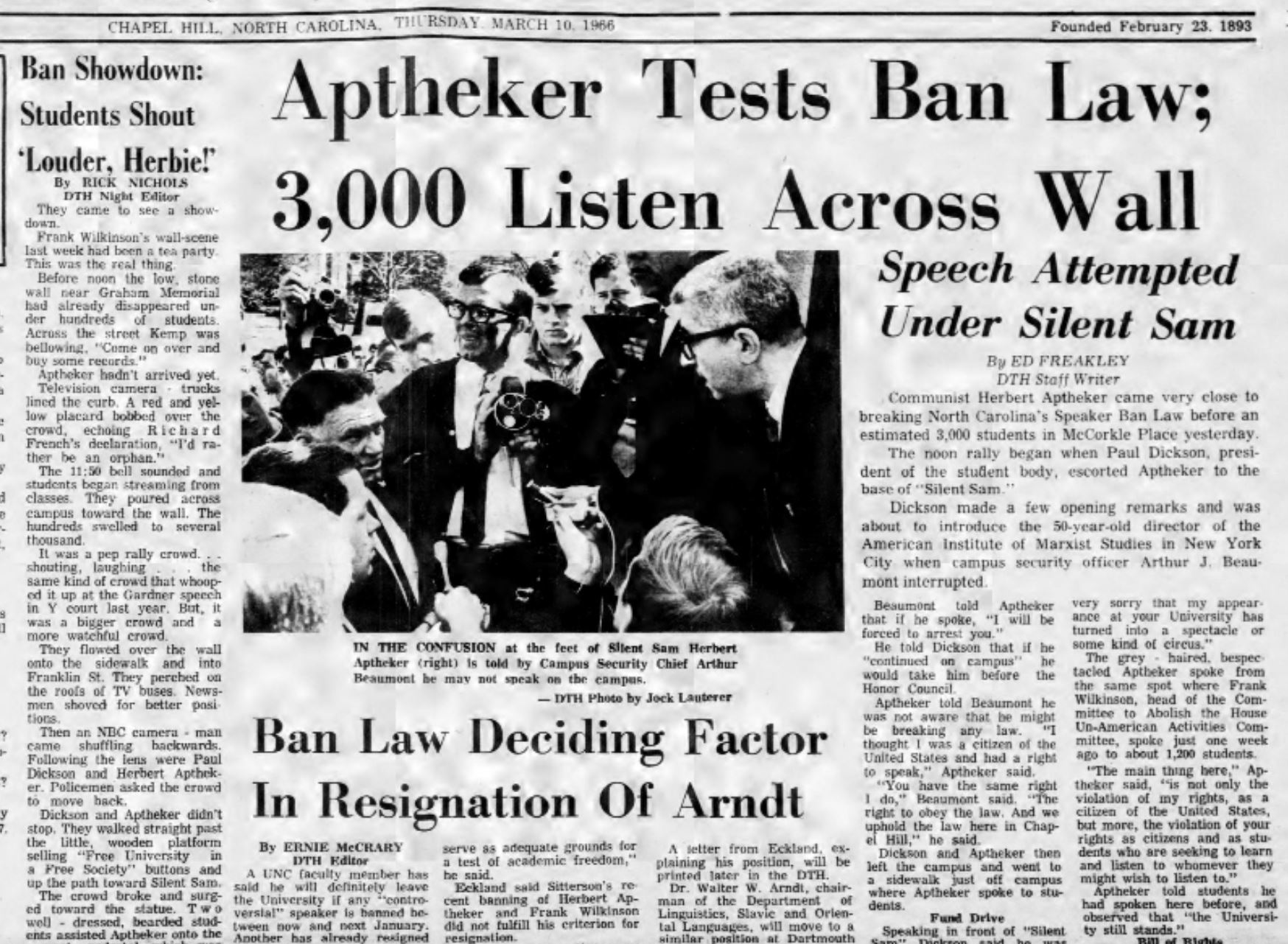
A chapter of Students for a Democratic Society (SDS) was formed subsequently in May of 1965 and organized masses of students opposed to the legislation. The SDS chapter held rallies of 800 and 1,300 student protestors, and was led by Paul Dickson III, UNC’s student body president. Dickson arranged for two banned speakers, Frank Wilkinson and Herbert Aptheker, to speak to students from the public sidewalk across the campus wall. These events laid the groundwork for Dickson, et al. v Sitterson, et al., which was ruled in favor of Dickson on February 19th, 1968. This decision came from the Federal District Court in Greensboro after two years of consideration, and gave hope to conservative lawmakers by expressing that “extremist” speakers did not further the educational experience.

The General Assembly finally repealed the Speaker Ban Law in 1995, which had been essentially unenforceable for 27 years.
References
A Look at UNC’s Bout with Censorship: The 1963 Speaker Ban
https://exhibits.lib.unc.edu/exhibits/show/protest/speaker-essay
https://ncpedia.org/speaker-ban-law
http://digital.ncdcr.gov/cdm/landingpage/collection/p16062coll12/
 Through the Lens of Time